 Tirsvad
0227b109d9
Six pages and a sidebar, each lecture step with its screenshot and what it
taught; review record RC-008.

Refs #14
Refs #15
Refs #16
Refs #17
Refs #18
29 lines
1.0 KiB
Markdown
29 lines
1.0 KiB
Markdown
# Step 4: fast against slow
|
|
|
|
**English** · [Dansk](Step-4-Fast-vs-Slow-da) · [Bahasa Malaysia](Step-4-Fast-vs-Slow-ms)
|
|
|
|
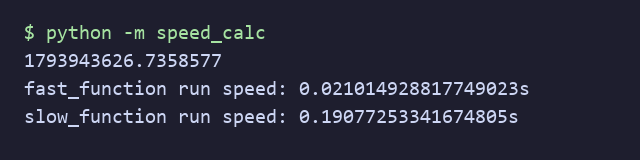
`@speed_calc_decorator` above both functions of the assignment gives the expected output:
|
|
|
|
```python
|
|
@speed_calc_decorator
|
|
def fast_function():
|
|
for i in range(1_000_000):
|
|
i * i
|
|
|
|
|
|
@speed_calc_decorator
|
|
def slow_function():
|
|
for i in range(10_000_000):
|
|
i * i
|
|
```
|
|
|
|
|
|
|
|
Run it with `python -m speed_calc`.
|
|
|
|
## What we gained
|
|
|
|
- One decorator times any number of functions; the timing code is written once.
|
|
- `slow_function` loops ten times as often as `fast_function`, so it takes about ten times as long. The numbers differ on every machine, but the ratio does not.
|
|
- A clean layout for a small exercise: `src/` for code, `tests/` for tests, `docs/` for documents, `constants.py` for constants, and Doxygen comments for the API.
|