
1.4 KiB
1.4 KiB
Lecture 1: Frontend, backend and the request-response cycle
English · Dansk · Bahasa Malaysia
What the lecture covers
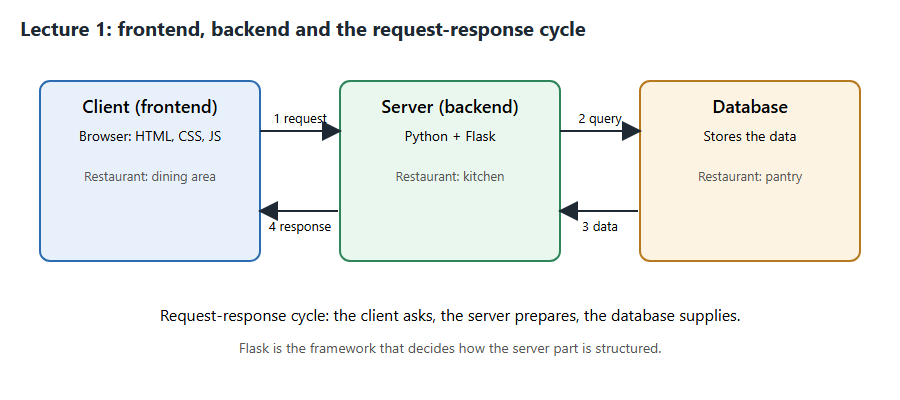
The lecture separates what the user sees (the frontend: HTML, CSS and JavaScript) from what the application does behind the scenes (the backend: Python, Java, Ruby and others). A backend has three parts: the client, the server and the database. A restaurant is the analogy: the dining area is the client, the kitchen is the server and the pantry is the database. In the request-response cycle the client asks, the server prepares and fetches data from the database, and the response goes back to the client. Flask is recommended for beginners and small projects; Django is the other well-known choice.
What we gained
- A vocabulary for talking about web applications: client, server, database, request, response.
- A reason to choose Flask: it is small and lets us see every part of the cycle.
- The knowledge that the rest of the course builds each of these parts step by step.
In this repository
The diagram is drawn from docs/images/sources/lecture-01.html; there is no code for this lecture.